 Halfway up the mountain we stopped once again to take on more water, and the passengers were able to grab a snack and a cup of coffee.


 Halfway up the mountain we stopped once again to take on more water, and the passengers were able to grab a snack and a cup of coffee.
 Over the Christmas break this year we planned a two week train trip to see a wide variety of the landscape and people of India. Our first leg of our journey to the Nilgiri hills, was spent in an overnight sleeper car, where it connects to the famous narrow gauge toy train to the hill station of Ooty.

 Here's what Wikipedia says about the train: The 'Nilagiri Passenger' train covers a distance of 26 mi (41.8 km),[2] travels through 208 curves, 16 tunnels,[2] and 250 bridges.[2] The uphill journey takes around 290 minutes (4.8 hours), and the downhill journey takes 215 minutes (3.6 hours) It has the steepest track in Asia with a maximum gradient of 8.33%.[2]

 Sorting out the Hindu festivals that are celebrated in India appears to be an impossible task to the foreigner. Not only because of the sheer number of them, but also because each region has it's own way of celebrating the different festivals. In addition, individual temples have their own festivals to honor the particular god or gods they may worship. One thing is certain, if there is a full moon, you can count on some sort of festival going on.

 Another part of the Navratri festival includes paying tribute to tools of one's trade, by decorating them, which explains why all the auto rickshaws are washed and covered with flower garlands, banana leaves, and designs drawn or splattered onto them with a colorful paste.
 Cars and automobiles are also dressed up for the occassion, and even I got into the act when our night watchman asked if he could decorate my motorcycle. I enjoyed showing off my flower garland and decorations, even though it did make viewing in my rear view mirrors a bit difficult.
 Umbrellas are a much needed accessory in India. During the Monsoon they sprout like mushrooms everywhere. In addition to being used in the usual fashion as a shelter from the rain while standing under them, they commonly pop up over motorcycles and bicycles. This seems odd to us westerners, but it really does keep some of the rain from pouring down on you, because the traffic in the city is generally not moving very fast.
 Here's another person who has decided to take a break from the onslaught, and answer a call on his mobile phone in front of the Chit Chat hotel. (A hotel is typically not a place to stay but a restaurant, and Chaat is a generic term for snacks prepared by the street cart vendors)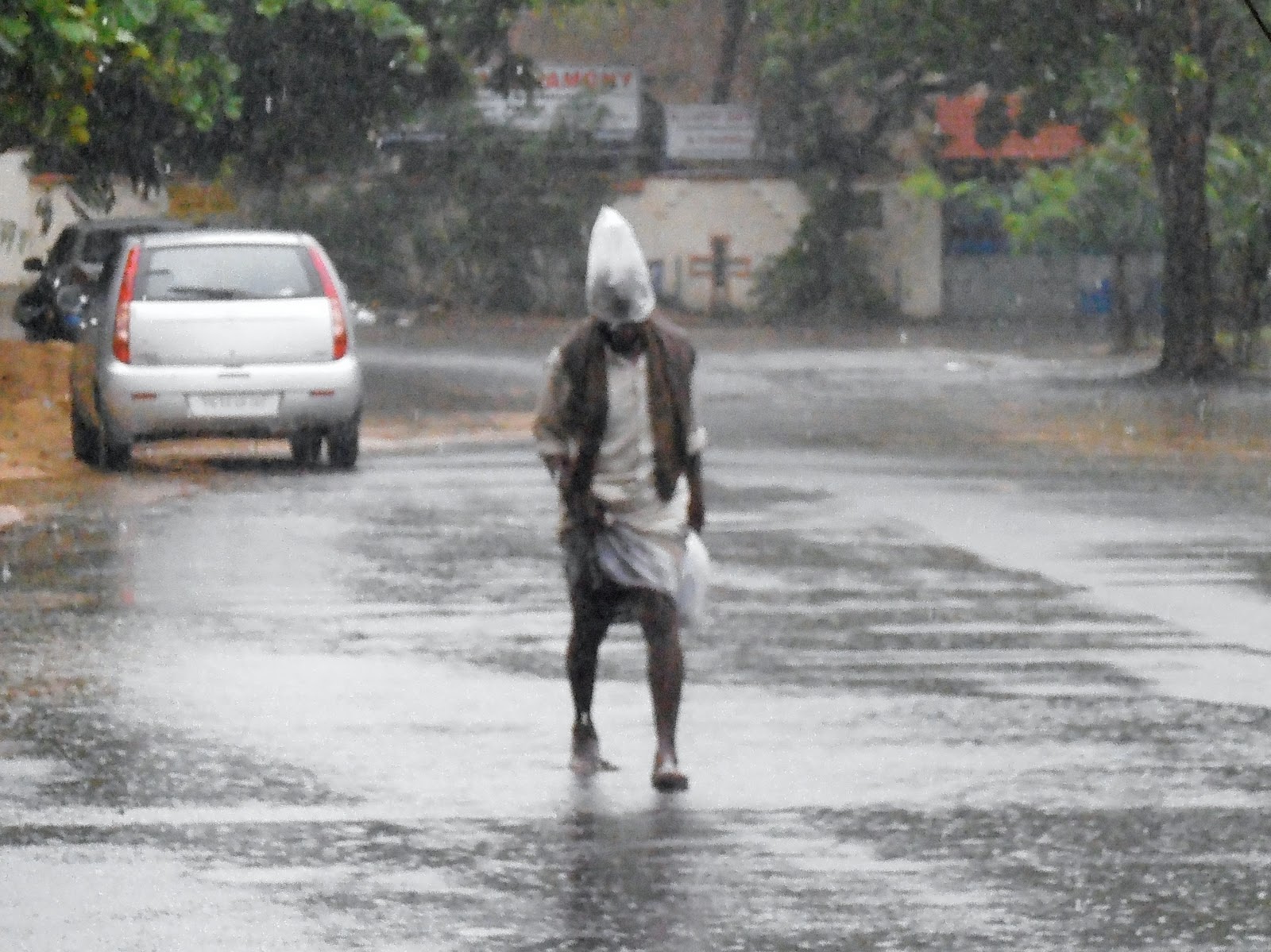

 Char and I were on a short holiday in the town of Pondicherry when the Monsoon hit with a vengeance. The skies opened up and it poured down rain for days. We had reservations outside of town at a retreat, so we donned our rain gear, climbed on our motorcycle and headed out in the driving rain through flooded streets. At times the water came up to our footpegs and engine. I was having visions of being stranded in this storm if the engine died on us. But our trusty 100cc Hero Honda plowed right through it all. When we reached the retreat, we were told they couldn't take us in due to the grounds being under water and the septic system was saturated. So we accepted a hot cup of tea, put our rain jackets back on and headed the 80 km back to Chennai. Fortunately the major highways are well maintained and built up enough that flooding is not as much of a problem as it is in the cities.
  The Monsoon season lasts for several months, with squalls and thunderstorms blowing in off the Bay of Bengal. At times the downpours come driving down in sheets, flooding the city streets.
  But the Monsoons are a happy time. They bring much needed water to the parched land, and the long hot season is broken. It is a sight for us "people from the cold country" to see people bundled up with wool caps, scarves and jackets when the temperature drops to a comfortable 78F.
 Life goes on during the Monsoon, the street vendors are still out selling their trinkets, the rickshaw drivers are still cruising for a fare, and the traffic is as bad as ever, though you have to be very careful when driving through the flooded streets that you don't fall into a foot deep pothole, or worse, a collapsed sewer cover, both of which are numerous.
 Much of the flat, low laying land that Chennai is built on was not long ago planted in rice paddies, which explains why this office of the chief engineer for state ground and surface water resources sits in the middle of a swamp during the rainy season.
  Concrete is the primary building material in this part of the world. Much of it is mixed with a hand shovel on the ground, put into buckets, then transported around the jobsite balanced on the head of a laborer, often women.


 Due to the harsh tropical environment and the inconsistent and generally poor quality of building materials, it is not long before the humidity, sun and vegetation take their toll on structures.
 The Indian traffic police have to be some of the bravest people in the world, as they stand out in the swarm of drivers and pedestrians, trying to create some sort of order out of apparent chaos.
 Murals like these are scattered throughout the city on the walls that often line the streets. From this picture you can not see the detail, but the artwork on these murals is very good. The paintings are typically of scenes from the area.
 We see an incredible array of things and any number of people being transported on the typical 100cc motorcyle. These guys are loaded down to play a music gig. Char made a comment to me the other day that we were probably photo worthy, as she climbed onto the back of our motorcyle with a guitar on her back, drum hanging at her side, and holding a mandolin in her lap.


