
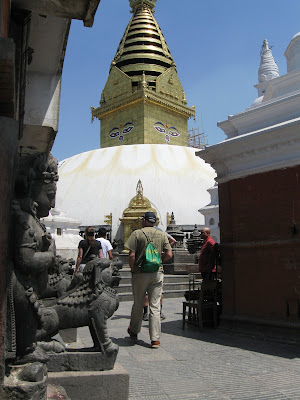
Swayambhu is one of the oldest Buddhist stupas in Kathmandu. It is part of a large complex that covers the top of a hill overlooking the city. These visitors were sending off their prayers.

The gold topped Stupa is surrounded by smaller temples, many with intricate stone carvings.


Stray dogs seem to be everywhere in Asia. Typically they are not at all aggressive and just want a garbage pile to rummage through, and a comfy bed where they can escape the heat of the day.

Swayambu is also called the Monkey Temple, because of the large population of Monkeys that inhabit the grounds.


If the smog is not to bad, there is a great view of the Kathmandu valley.


Swayambu is also called the Monkey Temple, because of the large population of Monkeys that inhabit the grounds.

This temple that is under renovation shows the typical bamboo scaffolding used at construction sites, though they often look much more precarious than this set up.

A woman spinning the prayer wheels as she walks around the Stupa in a clockwise direction. 

We were able to drive up close to the top of the hill, but many worshipers climb the steep steps, (365 I'm told).


If the smog is not to bad, there is a great view of the Kathmandu valley.

Many prayer flags strung from the trees flutter in the wind.


 Here's a family out cultivating a terrace with an ox drawn wooden plow.

 As in much of Asia, many things are done by hand. These people are threshing grain with a stick. Another man cuts firewood on a tool that looks like a paper cutter.

 We passed these colorfully dressed children playing on the dirt road. They were more than happy to comply when I asked if I could take their picture. Of course they promptly asked me for 10 Rupees. More often the kids would ask us if we had any chocolate.


 Outside the park, the most notable feature of this very steep terrain are the many terraces. It was not unusual to see entire mountains completely carved up with neatly stepped fields, newly planted with potatoes and corn.
 This picture of our guide (Ganesh) and Char, gives an idea of just how high these terraces are, typically ranging from 5 to 8ft. in height. I was surprised that erosion did not appear to be more of a problem, seeing that they are simply dug into the hillside without any kind of retaining walls.
 We had to hightail it to our next stop as a late afternoon thunderstorm caught up with us just before we reached our lodging.


