For friends, family and others who may be following our blog........ We will not be posting any updates while we are back in the US for the months of June and July. I hope you are enjoying the blog, which I will resume when I get some more pictures together in August.
Untill then, enjoy the summer!
Dave & Char
Sunday, June 26, 2011

Wednesday, June 1, 2011
Swayambhu

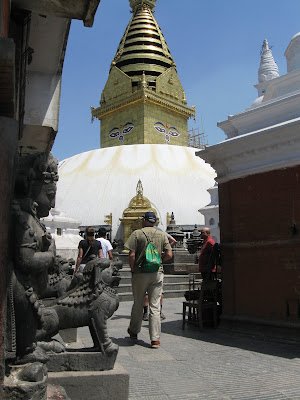
Swayambhu is one of the oldest Buddhist stupas in Kathmandu. It is part of a large complex that covers the top of a hill overlooking the city. These visitors were sending off their prayers.

The gold topped Stupa is surrounded by smaller temples, many with intricate stone carvings.


Stray dogs seem to be everywhere in Asia. Typically they are not at all aggressive and just want a garbage pile to rummage through, and a comfy bed where they can escape the heat of the day.

Swayambu is also called the Monkey Temple, because of the large population of Monkeys that inhabit the grounds.


If the smog is not to bad, there is a great view of the Kathmandu valley.


Swayambu is also called the Monkey Temple, because of the large population of Monkeys that inhabit the grounds.

This temple that is under renovation shows the typical bamboo scaffolding used at construction sites, though they often look much more precarious than this set up.

A woman spinning the prayer wheels as she walks around the Stupa in a clockwise direction. 

We were able to drive up close to the top of the hill, but many worshipers climb the steep steps, (365 I'm told).


If the smog is not to bad, there is a great view of the Kathmandu valley.

Many prayer flags strung from the trees flutter in the wind.

Monday, May 23, 2011
Endless steps
Much of our last day on the trail was spent climbing up and down newly made granite steps that went on and on, until we began to wonder if they would ever end. 
I've always liked rock work, so these steps really intrigued me because of the workmanship that went into building them. Some of the stones were very large and had to be extremely heavy, and they were all shaped into perfect right angles for the risers. The builders had dry fit everything without the use of mortar.

We couldn't help but wonder how all these steps had been made out here in the middle of nowhere, thinking it must have been done by the military.


I've always liked rock work, so these steps really intrigued me because of the workmanship that went into building them. Some of the stones were very large and had to be extremely heavy, and they were all shaped into perfect right angles for the risers. The builders had dry fit everything without the use of mortar.
From this picture, taken from the top of one set of steps, you can see the trail leading up the ridge to the summit of the hill we had just come down, steps all the way.

We couldn't help but wonder how all these steps had been made out here in the middle of nowhere, thinking it must have been done by the military.
We soon found our "military", which turned out to be a crew of a half dozen men armed with a couple of chisels and some rope.


And here's the quarry crew working on the hillside below the stair builders. I still don't know how they managed to get those heavy rocks up to the building site.

It is always a bit of a shock for a person like me from the US, who is so used to everything being done with power tools and earth moving equipment, to even consider a project of this size to be done with nothing but a few hand tools. But here labor is cheap, and people need jobs, so everywhere you look you see laborers like these guys (and women), with primitive tools, taking on large construction projects one step at a time.
Tuesday, May 17, 2011
Rural life
Outside park boundaries we were able to get a glimpse into life in rural Nepal. The small villages we passed through were sometimes no more than a couple of houses clustered on the hillside. The largest community we walked through consisted of 50 or more houses scattered about. These are farming communities, where families grow crops on land that has been handed down for generations. One store owner in Kathmandu, told us that many like him have to leave the villages for the cities because the family land is divided up so many times among the offspring, that there is often not enough acreage left to a family for subsistence. The hillside farming methods we saw have also been passed down from ancestors.
 Here's a family out cultivating a terrace with an ox drawn wooden plow.

Here's a family out cultivating a terrace with an ox drawn wooden plow.Every bit of available land is terraced and farmed, even in the larger villages like this one. As in much of Asia, many things are done by hand. These people are threshing grain with a stick. Another man cuts firewood on a tool that looks like a paper cutter.
 We passed these colorfully dressed children playing on the dirt road. They were more than happy to comply when I asked if I could take their picture. Of course they promptly asked me for 10 Rupees. More often the kids would ask us if we had any chocolate.
As in much of Asia, many things are done by hand. These people are threshing grain with a stick. Another man cuts firewood on a tool that looks like a paper cutter.We passed these colorfully dressed children playing on the dirt road. They were more than happy to comply when I asked if I could take their picture. Of course they promptly asked me for 10 Rupees. More often the kids would ask us if we had any chocolate. Monday, May 9, 2011
On the trail
 We had another day of trekking through Shivapuri park, while the last couple days took us through more small towns and villages, where we were able to get a glimpse into village life.
The weather continued to be perfect, though the mist continued to obscure our views of the high Himalayas. This area of Nepal is semi-arid, reminding me of the Sierra Mountains of California.
 Outside the park, the most notable feature of this very steep terrain are the many terraces. It was not unusual to see entire mountains completely carved up with neatly stepped fields, newly planted with potatoes and corn.
 This picture of our guide (Ganesh) and Char, gives an idea of just how high these terraces are, typically ranging from 5 to 8ft. in height. I was surprised that erosion did not appear to be more of a problem, seeing that they are simply dug into the hillside without any kind of retaining walls.
 We had to hightail it to our next stop as a late afternoon thunderstorm caught up with us just before we reached our lodging.
Thursday, May 5, 2011
Shivapuri trek
We started out early one morning with our guide to the outskirts of Kathmandu. A short car ride into the foothills took us to the end of the road, where it turned into a flight of ancient stone steps. We didn't know it at the time, but these were the first of many seemingly endless steps we would encounter throughout our four day trek. At other times our route would consist of more moderate to very steep footpaths, which is still the only access to some of the homes and villages we passed through. 
Our trail also took us on dirt roads that have been constructed in some of the more remote regions by the Nepal military. Most of these have very little vehicle traffic, indeed many are impassible to anything but a 4x4 or motorcycle.
The locals appear to still live a mostly traditional, subsistence style of life. This picture of a family drying grain and their laundry on the front porch appears timeless, except for the modern motorcycle.

Our trail also took us on dirt roads that have been constructed in some of the more remote regions by the Nepal military. Most of these have very little vehicle traffic, indeed many are impassible to anything but a 4x4 or motorcycle.
The locals appear to still live a mostly traditional, subsistence style of life. This picture of a family drying grain and their laundry on the front porch appears timeless, except for the modern motorcycle.
For noon we stopped at this wayside restaurant, where we rested our legs and had a bowl of ramen.

The water supply to many of the villages is nothing more than a spring fed pipe like this one by the side of the road, where a woman is washing her clothes.
We continued our climb to the entrance of Shivapuri Park. This large protected area has been set aside to preserve a major watershed for Kathmandu.


Inside the park, we left behind the smog of Kathmandu, and began to see the many terraced hillsides. Other areas were still in the wild state with a mix of hardwoods, a few pines, and large rhododendron trees, some in bloom.

Our first stop was the "town" of Chisapani, which is nothing more than a few guesthouses, catering to trekkers.
By outward appearances, our lodge looked pretty deluxe. Inside it was a different story, but we lucked out with a top floor room with a view, and a private bath.
Here I am, resting my tired body on our balcony. There is a good view of the high Himalayas from here, unfortunately we never saw more than their outlines through the persistent haze they were shrouded in. All the same the lower elevations are beautiful, and the cool, clean air was a very welcome relief from the heat and humidity of India.


The water supply to many of the villages is nothing more than a spring fed pipe like this one by the side of the road, where a woman is washing her clothes.

We continued our climb to the entrance of Shivapuri Park. This large protected area has been set aside to preserve a major watershed for Kathmandu.


Inside the park, we left behind the smog of Kathmandu, and began to see the many terraced hillsides. Other areas were still in the wild state with a mix of hardwoods, a few pines, and large rhododendron trees, some in bloom.

Our first stop was the "town" of Chisapani, which is nothing more than a few guesthouses, catering to trekkers.

By outward appearances, our lodge looked pretty deluxe. Inside it was a different story, but we lucked out with a top floor room with a view, and a private bath.

Here I am, resting my tired body on our balcony. There is a good view of the high Himalayas from here, unfortunately we never saw more than their outlines through the persistent haze they were shrouded in. All the same the lower elevations are beautiful, and the cool, clean air was a very welcome relief from the heat and humidity of India.

Monday, May 2, 2011
Pashupatinath Hindu Temple

Pashupatinath is an important temple located on the Bagmati River on the outskirts of Kathmandu. It is a large complex where many cremations are held on the river banks. When we were there in April the river was little more than a trickle and like all the rivers in the populated areas, it had the unforgettable smell of sewage and garbage. A smell that has become all to familiar too us. In spite of the pollution, it is considered a holy river, and people bathe here to purify themselves.

Family relatives of the deceased also return here a year after their death to feast by the river.

Family relatives of the deceased also return here a year after their death to feast by the river.
Sadhus, or wandering monks, are at the last stage in their quest for a release from the wheel of life, which is the cycle of birth and reincarnation. Sadhus have renounced all material and sexual attachments, and live off the offerings of others. Maybe my small offering in exchange for a picture of these two will add to my good karma.

The temple itself sits above the river and is surrounded by many smaller shrines.


This shrine had some amazing architectural details.


The temple itself sits above the river and is surrounded by many smaller shrines.


This shrine had some amazing architectural details.

Just upriver from the temple there are cave dwellings built into the hillside. I understand these are for monks who come here for retreat and meditation.


 One area had a whole series of identical shrines in a row. This gives an interesting double mirror effect when you look through the first, down the line.


 One area had a whole series of identical shrines in a row. This gives an interesting double mirror effect when you look through the first, down the line.
Unlike the temples in Southern India, we were unable to enter the temple walls, where a Hindu only sign is posted at the entry doors. We were able to catch a glimpse into the courtyard of the rear end of the huge statue of Shiva's gold plated bull he rides.


Subscribe to:
Posts (Atom)
