Thursday, February 10, 2011

Life around the Temple


There is always a lot of activity that goes on around the temples. Besides the usual traffic and vendors, you will always find women stringing jasmine and other flowers into braids that are worn by the women in their hair, or used for offerings to the gods. Other vendors offer incense, coconuts and many other things that are used in various rituals.


Coming from a much colder climate, I am always surprised when I see someone with earmuffs or a knit scarf on their head in the "cold" season, when it might get down to about 70F.


This women was selling lemons and bundles of turmeric which is used for rituals this time of year. To many people here, their religion is a way of life, that is incorporated into their daily life. It seems that almost every day of the Hindu calender is full with some festival or other. There are also auspicious days when a person should or should not make important decisions.


The area around the Kapaleeswarar temple still has some traditional homes around, though sadly, many like this one are being torn down to make way for multi-story apartments. These older homes have wonderful courtyards that the living space is designed around, so you always have a lot of air and light. The courtyard is always recessed to catch the rain from the roofs.

Many houses have their own space reserved for a shrine for daily worship.


Tuesday, February 1, 2011

Kapaleeswarar Temple

Back in Chennai I had the opportunity to be a tourist for a day in our own city. A small group of us had signed up with a tour outfit called Storytrails. The guides are locals who lend a personal touch by emphasizing the traditions and local lore of an area. Our destination was Mylapore, an area only a couple of kilometers from our apartment where the Kapaleeswarar Temple is located, one of the biggest tourist attractions in Chennai.


Note that you can click on the pictures for more details.


Mylapore was once one of the largest and most powerful villages in Southern India, visited by Marco Polo, and surviving as a dominate kingdom until it was subjugated by the British. Being close to the British fort, it was one of the many villages that would eventually be incorporated into the city of Madras (After India gained it's independence from England, many colonial names were changed, Madras being renamed Chennai).


Because of Mylapore's prominence, it has one of the largest and oldest temples in Chennai. The original ancient temple close to the beach is no longer. The Kapaleeswarar temple that stands today was built three to four hundred years ago further inland, using some of the stones from the original.
The Gopuram is the large pyramid that towers over the entrance to the walled temple. These pyramids are terraced with sculptures in stucco from the many Hindu stories.

Inside the massive 12'-14' tall doors is a courtyard that holds the main sanctuary, which is reserved for people of the Hindu faith, and many other smaller temples dedicated to various deities.


Worshipers will stop to pray at the different shrines, always circling in a clockwise direction, keeping their right side to the inner sanctuary. As I understand it, the right side of the body is considered to be clean or pure, which is also why it is customary to greet someone or eat with your right hand, reserving the left for taking off your shoes or other "dirty" tasks. On a side note, it takes a little practice to be able to eat in the traditional manner, without implements, using only your right hand, without making a complete mess of things.


Temples serve as a center for social activities, where people can hang out, worship, hear concerts or hold important events such as weddings at the open hall.


Near the larger temples you will always find a "tank" or pond. I'm not sure, but I believe they serve a very practical pupose for water storage.

Monday, January 24, 2011

Tropical paradise

For the last leg of our Sri Lanka trip we continued up the coast with it's beautiful beaches that are right out of the pages of a "wish you were here" calendar. If I had known what to expect, I would have booked us longer at this appropriately named Palm Paradise Cabanas. The cabins have complete baths and you can open them up to the sea breeze and the sounds of the waves to lull you to sleep at night.


The beaches are quiet and more pristine this far south, away from the large population area of Colombo.

This fellow just snagged a small fish, using the typical long stick for a fishing pole.


Further up the coast the small city of Galle is popular with both tourists and the locals.


This family had a unique way to keep their youngster out of trouble for awhile.


There were reminders everywhere that this paradise had fairly recently been hit with the force of a devastating wave that is hard to fathom.


New Year's eve was spent at a beach resort where the management put out an incredible buffet with dishes from all parts of Asia. The tables were adorned with some amazing works of art made from butter. Char & I had the dance floor mostly to ourselves as the band played an interesting mix of old US covers and local songs.


I took this photo from the balcony in our room in Colombo to try to capture what you witness everywhere in Sri Lanka and India. The poor housing district next to our nice hotel, screened by a thick hedge, where you can spot satellite dishes on the roofs. In the block beyond, new high rise apartments have sprouted.

Wednesday, January 19, 2011

Yala National Park

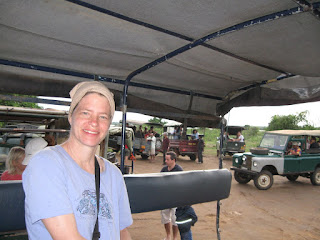
The sun was not yet up when we climbed onto the bench mounted in the back of a Toyota safari vehicle. A half hour later we were at the entrance to Yala park along with about 20 other similarly loaded vehicles whose occupants were hoping to see elephants and leopards. Sri Lanka recognizes the assets they have with their abundance of wildlife, and to their credit they have set aside large wildlife refuge areas and elephant migrations routes throughout the island.
Yala is one such park that allows people in, though most of the park is not open to traffic, and you are not permitted to get out of your vehicle while in the park.


The park is located on the ocean and is a mix of dense shrubs, grassy plains, rocky outcroppings and many small lakes and ponds.


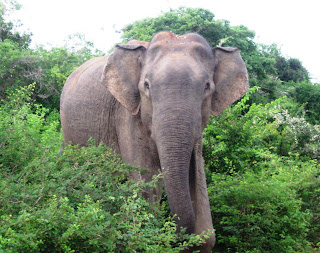
Once inside the park our driver/tracker took us on a side road and were soon greeted by a bull elephant who appeared out of the thick brush, checked us out, then meandered on his way. I would have never thought an elephant could hide, but if our driver had not pointed him out, I would have driven right by him. We were not disappointed by the abundance of wildlife, including water buffalo, deer, including some stags with very large antlers, monkeys, monitor lizards, wild pigs, wild dogs and crocodiles. The elusive leopard however remained out of sight that day.

We also spotted shore birds and raptors of all kinds.


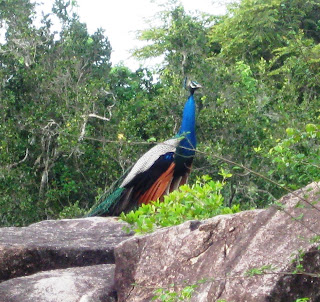
There were also many Peacocks about. We caught this one strutting his stuff.


At lunch many of the vehicles congregated on the beach where we were allowed off the rig to stretch our legs. There is a sobering memorial here dedicated to the victims of the Tsunami who lost their lives at this once posh resort. All that was left after the water had receded was this concrete foundation and bits of building scattered about the area. Everything else was washed out to sea.


During most of our Safari, we had the roads to ourselves, but after lunch all the rigs had stopped to see a small herd of elephants. The big beasts seemed used to the idea of people gawking at them as they passed calmly by.


Monday, January 17, 2011

Over the pass

After a very pleasant overnight stay at a old mansion that had recently been converted to a hotel we climbed on the beast again and headed for the southeast coast. The mansion had an interesting history because the prominent family that still owns it used to entertain famous people here. We can now say we walked the same floors as Mahatma Gandhi and Gregory Peck.


From Kandy we climbed up endless switchbacks, to the town of Nuwara-Eliya which has an elevation of 1980 meters (6,500 ft.). Part way up we stopped to buy some more lemon munchie biscuits at this little store perched on concrete stilts. The view from the extended slab looking out over the hills was fantastic. This area is tea country, where the hills are terraced with tea plantations, right up to the top of some incredibly steep mountains. The women who pick the leaves throw them into a bag that was slung on their backs. I could not help but think of the cotton pickers before modern harvesters were introduced.


Our next stop was at the edge of the hill country where we were awakened every morning at 5:30 by the call to prayer blaring from loudspeakers at the mosque across the street. This area has a large Muslim population who originally settled here to escape the Portuguese domination of the coastal areas.


The next day found us back in the rice paddies of the flat plains where we had made arrangements for a jeep safari into the Yala wildlife refuge.

Friday, January 14, 2011

Sri Lankan Folk Dancers

We had been told that we should see one of the traditional dance shows while we were in Kandy, so we purchased tickets at the local YMBA (no it's not a typo, it stands for Young Men's Buddhist Association). The performance lived up to it's reputation as the women pranced around in some beautiful costumes and the men showed off their abilities doing some truly amazing gymnastics in their elaborate garb of cloth and metal.
The dancer's musical accompaniment, consisted of a half dozen percussionists with drums of various sizes and pitches and an occasional song included a oboe type instrument.


This particular act of spinning flat clay drums on sticks brought back memories of the old Ed Sullivan show.


At the end of the show, the audience was led outside where several men performed a fire dance where they tried to incinerate themselves with kerosene as they walked across a burning pit or flung burning torches around.
The night we attended the show the hall was full of European, Slavic and Indian tourists. It emphasized for me that it was the tourist dollar that was keeping many of the traditional customs alive, much like the elephants at the orphanage. (As a side note I really do mean US dollars which are used as a sort of second currency in Sri Lanka.) If not for those dollars I fear these dances would be lost to the 21st century which would be a real loss for the world.


Thursday, January 13, 2011

Gardens, Kings & recent history

Located just outside Kandy is the large Paradeniya botanical garden that was originally kept for the royal family. The large grounds are kept immaculate and include just about every imaginable type of garden with plants imported from around the world. The gardens were one of the highlights of our trip as we wandered for hours in perfect weather through arboretums, bamboo groves and various formal gardens.


Giant bamboo is fairly common on the island, but it was our first encounter with stalks as large as palm trees.
One gardener motioned for me to check out this colorful spider and it's interesting web.
Another caretaker unrolled a large leaf he had pulled from his pocket to reveal a 4-5" scorpion. It was worth the few rupees he extracted from us for the photo.


Some of the trees grew to enormous size in this tropical environment. If you look closely at this picture you can get a sense of proportion by the lovers nestled in the roots of this tree under their umbrella.


Visiting Kandy where the Monarchs have left their legacy of the lake and gardens left me with an impression of just how powerful and luxuriously they had lived before the arrival the Portuguese, Dutch, and later the British. The isolated hill country of Kandy remained a region ruled by the last king of Sri Lanka until the early 1800's when local chiefs, who felt they would be better off under British rule than the oppressive king, banded together to cede the kingdom to the British.
Sri Lanka is a country that has been hard hit in recent history by a civil war between different ethnic groups and the politics of creating a government in the void left by British rule. Today there are soldiers and checkpoints everywhere you go, with locals frequently pulled over on the road at random. We were only stopped once where we were politely but thoroughly questioned about our itinerary. On the heels of the war the 2004 Tsunami hit the coast, where there are still remains of ruined buildings and many recent roadside graves, evidence of the devastation it caused.
Today Sri Lanka is at peace and is rebuilding at a rapid pace with new private and public works projects every where you go. You can feel the mood of the country in the air, and when talking to the locals, you get a sense of relief that the worst is behind them, and an optimism about moving on to the future.