I have previously mentiond that the traffic is one of the first things you can't help but notice in Chennai. I found this video on youtube that is pretty typical of an auto rickshaw trip in moderate traffic, much like Char's commute to school every day. Of course, video is nothing like being in it with horns blaring all around you and the occasional cow or 2 wheeler (motorcyle) coming at you the wrong way. Bear in mind also if there are lines on the road, they are totally ignored with people darting into the tiniest openings. Note the women often ride sidesaddle and miraculously manage to stay on their perch most of the time. It's amazing what we see on the small motorcyles. There are often 4 or even 5 family members on one bike, with the next to youngest on the tank, holding onto the mirrors and the baby squished between her mother and sister, sound asleep. We also see motorcyle drivers or passengers carrying all sort of objects from TV's to ladders. When it rains, the passenger is often holding and umbrella over their heads. A lot of chickens also get delivered, dead or alive, to market hanging and stacked on all sides of a 2 wheeler.
The amazing thing is that it all works somehow, flowing along most of the time about 20-25 MPH, faster on the better arterials. The #1 rule I have learned is, don't look back, grab every inch of space you can and just keep moving.
By the way Char and I both wear helmets!
Sunday, November 7, 2010

Diwali and a near miss by Cyclone Jal
 We first started hearing the fireworks a week ago, and I don't mean the little firecrackers and sparklers we see in the states. These were M-80's and major pyrotechnics that you see at organized fireworks shows that anyone could buy at the many fireworks stands that had sprung up on the streets. People were gearing up for Diwali. By the 4th day of the holiday the firecrackers were nonstop all day starting at 5:30 AM. When night fell on the city, it literally exploded with people setting off major fireworks from every street and rooftop in this city of millions. The next day and night were a repeat, but incredibly even more intense. We began to get a sense of what it must be like to be in a city under siege.

Of the many Indian holidays Diwali is probably the most celebrated in South India. People take the day off and visit family, exchange presents and light clay candles around the house. Diwali marks the start of the Indian lunar calender new year and it also celebrates the return of the legendary prince Rama to Ayodhya. His story is one of many that is interwoven into the Hindu religion. Char and I are currently reading a recently rewritten version of the Ramayana (Rama's story) by Ashok Banker, which is a great read, very much like reading a Tolkien story, complete with monsters, gurus and witches. Be warned though, the whole story occupies 6 volumes.
After the 5th day when the fireworks had finally died down to a trickle we heard of Cyclone Jal which was heading straight for Chennai. Fortunately by the time it hit it had lost most of it's strength so not much happened here other than a few broken branches and some fairly heavy rains. But this morning is beautiful, even cool (75F), cool for here that is! The other good thing to come of the storm is they cancelled school, anticipating the worse, so Char gets the day off!
Thursday, October 21, 2010
NYC 100 years ago
I picked up a book the other day in Char's classroom titled "If You Lived 100 Years Ago". It is a children's book about what life was like in New York city. As I turned the pages I was shocked to see all the parallels I see in every day life here. People buying most of their produce from street stands, and many wandering tradesman with their particular call collecting used paper, the knife grinder with his portable wheel, the umbrella repairman, or the coffee vendor on his bicycle. The descriptions of some of the tenements reminded me of some of the poorer, more crowded areas of town. The beach scene in the book could have been painted at Chennai, women wading in full dress, the men jumping into the water in their pants, not to mention the high wire act and the hand cranked carousel. As the list of similarities grew with each page it came to me that I was in some respects living that life from yesterday. The difference of course is that India has it's other foot in the modern world we know in the US. Everyone has a cell phone, many people have motorcycles or cars, computers and TV's are common, people can shop in a modern mall, electricity is pretty reliable and modern high rises are popping up everywhere. I think the most important difference is the population as a whole is very well educated. This blend of old and new make for a very interesting mix! One of the most refreshing things for me to see is that the vast majority of businesses are small family run operations, though some larger chains are starting to pop up. I can envision a future India much like the US where mega corporations control most of the markets. (Coca-Cola has a huge business here selling bottled water)
I was also struck with the descriptions of the dirt and garbage in the NY streets one hundred years ago. The amount of litter and the pollution of the waters here is one of the hardest things for us to adjust to. There is some awareness of conservation and you see signs here and there about keeping Chennai clean and green, but it seems like an impossible task against the sheer number of people, and the often inadequate sewer and garbage infrastructure. Perhaps the larger problem is the apparent disregard by many for their surroundings. Men will stop to piss anywhere they please, people toss their litter onto the street and the many loose dogs and cows don't help.
The book also alluded to the idea that 100 years ago in New York people were generally much more focused around their families and extended families. Family members depended on each other for survival. This too seems like a parallel from what I have observed, family comes first, and often grandparents are involved.
It is my hope that India is able to keep the important values and culture it cherishes and learn from and avoid mistakes made by other industrialized nations as it leap-frogs into a new era.
Tuesday, October 19, 2010
Mamallapuram continued
 We spent our second night in town at a small restaurant/hotel called the Blue Elephant. It is located on a street lined with shops and restaurants, most of these open to the street, a bit of French influence. This picture was taken from our hotel which was also open to the elements. I thought this would be the funkier of our accommodations, but it turned out to be very clean and the food was good.
One of the sights to see in town is the Five Rathas, most of which have been carved out of one large rock outcropping.


I took this photo opportunity to show what looks to me like the typical South Indian Family on vacation.

A closer look at the amazing bias relief carving of all sorts of men, gods and beasts representing creation. Most of the ancient carvings and cave temples in this area date to around 600-700 A.D.


At the highest point of the granite hills is a stone building that was used as a signal tower. Fires were lit here and could be seen for many miles around from land and sea. It has been replaced in modern times by an electric lighthouse. 


Saturday, October 16, 2010
Return to Mamallapuram
 Char had a week off last week so we spent a couple of days in Mamallapuram, which she had not yet seen. Our first night was spent at a Resort that catered mostly to the Indian Tourists, not exactly the 4 star Ideal Beach Resort right down the road, but we had a ocean view and it has a nice waterfront. The difference being a lack of maintenance and toilet paper.
This small town had been a major port around 500-800 AD and is full of temple caves that have been carved into solid granite outcroppings.  The shore temple here is one of the oldest temples in Southern India.


 On the way down we stopped at a coconut vendor's stand, which is where they cut the top out of a green coconut and you drink the juice through a straw. Here we met "Coconut Raj" who survived to tell about the 2004 Tsunami. As he was setting up his cart early in the morning on the beach he saw the wave coming towards him. It flashed through his mind that he needed to save his business, but his life was more important. He made a run for this rock column which a person can climb from the back side (See Dave in picture for perspective). He made it to the top before the wave hit. In ten minutes it was over, but he sat on that rock for eight hours, afraid to move. He doesn't know why, but is glad the gods saved him that day.

Sunday, October 10, 2010
Dakshina Chitra
 Just south of Chennai there is a site run by a non-profit organization whose purpose is to maintain & promote the cultures of South India. Here they have faithfully re-created or moved typical houses circa 1900, from the Southern states of Tamil Nadu (where we live), Kerala, Karnataka & Andhra Pradesh. They also have craftspeople making and selling traditional arts & crafts.

Many of the homes had very detailed carvings on the structural components as well as the doors.
 The larger Stucco & Wood houses all had a central area with a recessed floor where rainwater is directed from the open roof above. As well as being very functional, this created a very open "courtyard" in what would otherwise be a very dark interior.


 The larger Stucco & Wood houses all had a central area with a recessed floor where rainwater is directed from the open roof above. As well as being very functional, this created a very open "courtyard" in what would otherwise be a very dark interior.


This weaver is making a Sari on a traditional pit loom which stretches across the whole room. It takes him about 10 days for each 6-9 yard length.


India's version of a fife & drum corp.

A potter intent on his work, and a thatched house that a typical villager would have lived in.

 Char & I thought this was a great idea for a chicken coop.


India's version of a fife & drum corp.
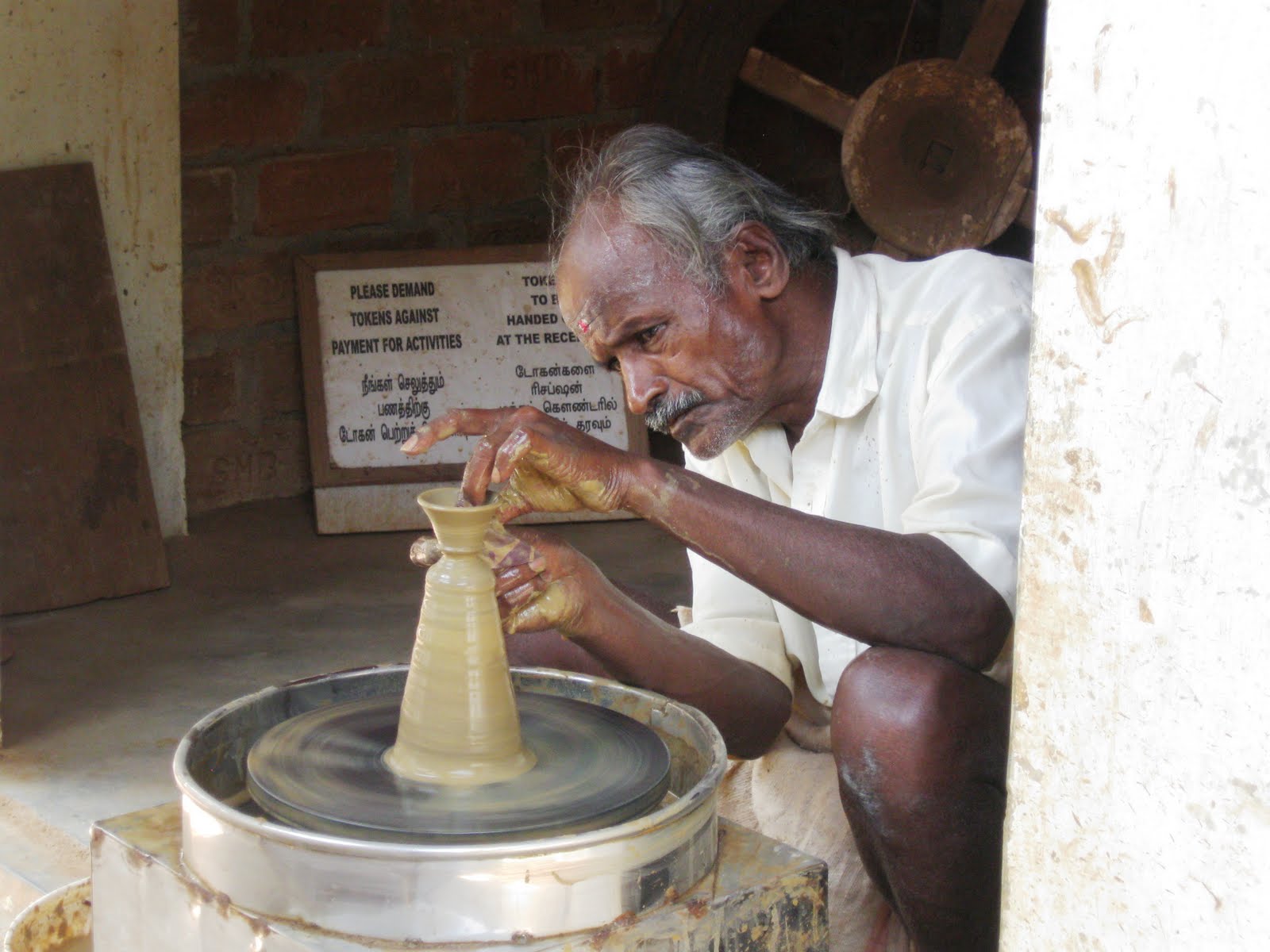
A potter intent on his work, and a thatched house that a typical villager would have lived in.

 Char & I thought this was a great idea for a chicken coop.
Wednesday, October 6, 2010
Misc. street scenes
Parades by devotees happen on a fairly regular basis, especially on Fridays. I never know when, or on which major arterial they are going to occur. This group does not include the body piercing I witnessed earlier.


This women is holding a lantern made from a gourd who was going around the street stalls at Pondy bazaar which is a very large shopping area of town. I suspect she is giving a blessing, though I am not familiar with all the local rituals.

There is a museum at the center of town, which is rather run down, but has some nice grounds and interesting buildings built during the British rule. With the exception of some of the older buildings and the use of a lot of broken English language, there is very little evidence the British had ever ruled here. We did not go into the museum because entry fees for tourist attractions are the one place where I have seen discrimination. Locals can get in for about 15-20 Rupees, but foreigners are charged up to 250. That is only about 5 bucks, but we didn't feel like perpetuating that mindset, at least not for this attraction.

Around the museum theater are some old cannons. The ornate details of this one caught my eye. A sign at the base dates it to 1799.
Subscribe to:
Posts (Atom)
