Tuesday, October 19, 2010

Mamallapuram continued

We spent our second night in town at a small restaurant/hotel called the Blue Elephant. It is located on a street lined with shops and restaurants, most of these open to the street, a bit of French influence. This picture was taken from our hotel which was also open to the elements. I thought this would be the funkier of our accommodations, but it turned out to be very clean and the food was good.


One of the sights to see in town is the Five Rathas, most of which have been carved out of one large rock outcropping.


I took this photo opportunity to show what looks to me like the typical South Indian Family on vacation.

A closer look at the amazing bias relief carving of all sorts of men, gods and beasts representing creation. Most of the ancient carvings and cave temples in this area date to around 600-700 A.D.


At the highest point of the granite hills is a stone building that was used as a signal tower. Fires were lit here and could be seen for many miles around from land and sea. It has been replaced in modern times by an electric lighthouse.


Saturday, October 16, 2010

Return to Mamallapuram

Char had a week off last week so we spent a couple of days in Mamallapuram, which she had not yet seen. Our first night was spent at a Resort that catered mostly to the Indian Tourists, not exactly the 4 star Ideal Beach Resort right down the road, but we had a ocean view and it has a nice waterfront. The difference being a lack of maintenance and toilet paper.


This small town had been a major port around 500-800 AD and is full of temple caves that have been carved into solid granite outcroppings. The shore temple here is one of the oldest temples in Southern India.


On the way down we stopped at a coconut vendor's stand, which is where they cut the top out of a green coconut and you drink the juice through a straw. Here we met "Coconut Raj" who survived to tell about the 2004 Tsunami. As he was setting up his cart early in the morning on the beach he saw the wave coming towards him. It flashed through his mind that he needed to save his business, but his life was more important. He made a run for this rock column which a person can climb from the back side (See Dave in picture for perspective). He made it to the top before the wave hit. In ten minutes it was over, but he sat on that rock for eight hours, afraid to move. He doesn't know why, but is glad the gods saved him that day.

Sunday, October 10, 2010

Dakshina Chitra

Just south of Chennai there is a site run by a non-profit organization whose purpose is to maintain & promote the cultures of South India. Here they have faithfully re-created or moved typical houses circa 1900, from the Southern states of Tamil Nadu (where we live), Kerala, Karnataka & Andhra Pradesh. They also have craftspeople making and selling traditional arts & crafts.


Many of the homes had very detailed carvings on the structural components as well as the doors.

The larger Stucco & Wood houses all had a central area with a recessed floor where rainwater is directed from the open roof above. As well as being very functional, this created a very open "courtyard" in what would otherwise be a very dark interior.


This weaver is making a Sari on a traditional pit loom which stretches across the whole room. It takes him about 10 days for each 6-9 yard length.


India's version of a fife & drum corp.


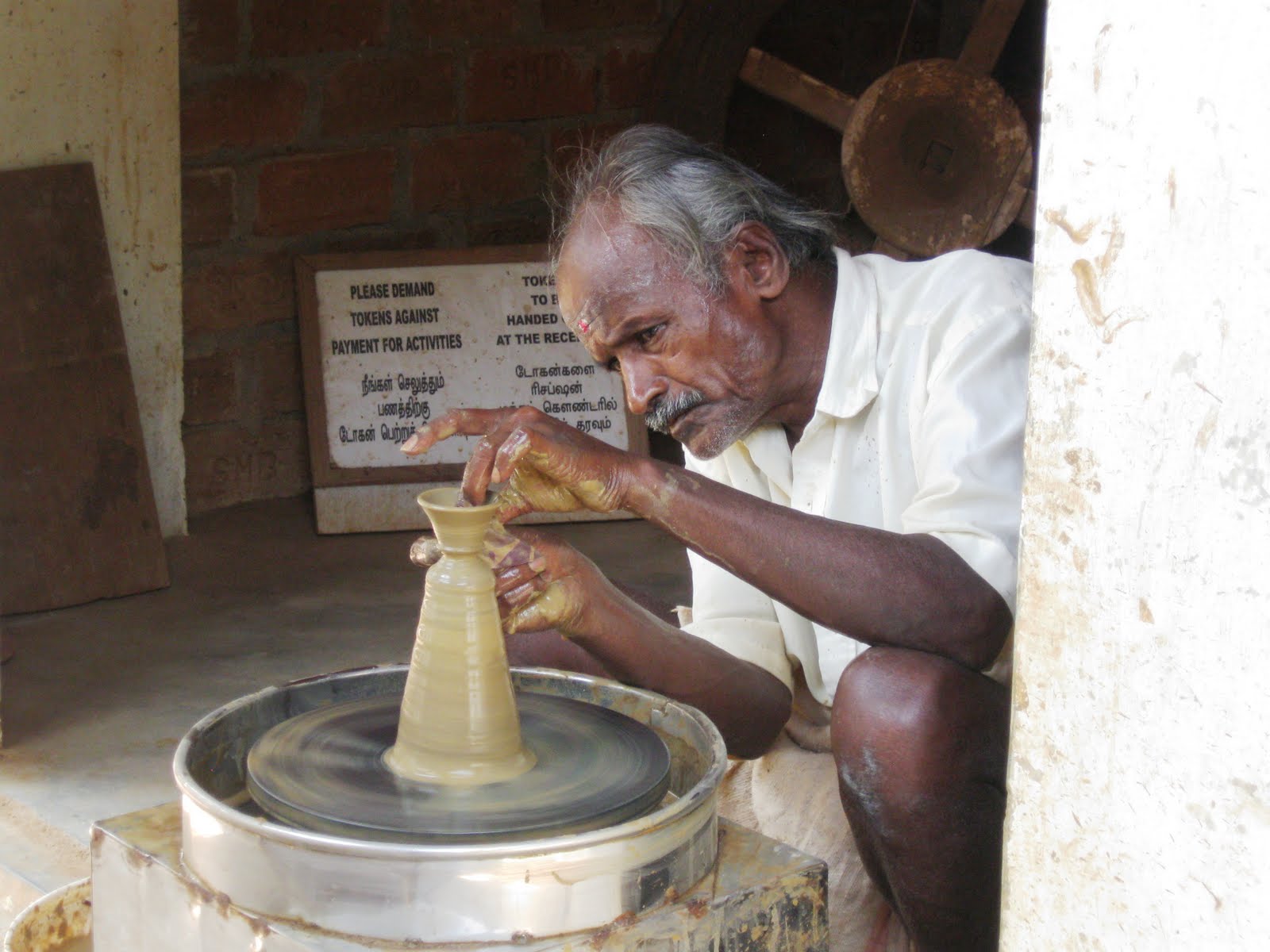
A potter intent on his work, and a thatched house that a typical villager would have lived in.


Char & I thought this was a great idea for a chicken coop.


Wednesday, October 6, 2010

Misc. street scenes

Parades by devotees happen on a fairly regular basis, especially on Fridays. I never know when, or on which major arterial they are going to occur. This group does not include the body piercing I witnessed earlier.


This women is holding a lantern made from a gourd who was going around the street stalls at Pondy bazaar which is a very large shopping area of town. I suspect she is giving a blessing, though I am not familiar with all the local rituals.


There is a museum at the center of town, which is rather run down, but has some nice grounds and interesting buildings built during the British rule. With the exception of some of the older buildings and the use of a lot of broken English language, there is very little evidence the British had ever ruled here. We did not go into the museum because entry fees for tourist attractions are the one place where I have seen discrimination. Locals can get in for about 15-20 Rupees, but foreigners are charged up to 250. That is only about 5 bucks, but we didn't feel like perpetuating that mindset, at least not for this attraction.


Around the museum theater are some old cannons. The ornate details of this one caught my eye. A sign at the base dates it to 1799.


Thursday, September 30, 2010

St. Thomas Mount


A couple miles from our apartment is St. Thomas mount where it is believed "doubting Thomas" was killed in AD72. This 300ft. hill is the highest point of ground in the area, with a series of steep steps leading to the summit. The views of Chennai are pretty impressive.


The small church at the summit was built by the Portuguese in the early 1500's.

The history before that is a bit sketchy but there is supposed to have been a previous church at this location that was demolished by other religious groups.


When the Portuguese builders were constructing their church, they uncovered a carved stone, said to be carved by St. Thomas himself. The stone is known as the bleeding stone, because it is reputed to have wept blood on numerous occasions.

Beside the stone is a painting of Mary that I was told was painted by St. Luke for St. Thomas.


Friday, September 24, 2010

Koyambedu Market

The Koyambedu market is one of the largest wholesale fruit and vegetable markets in Asia, with seemingly endless rows of stalls each with basketful's of produce or neatly stacked pyramids of apples, tomatoes, coconuts, artichokes, or rows of bananas and plantains still on the stalk. A person could walk for miles, in the several hours I spent here, I saw less than half the complex.


There is a separate building that houses a large flower market. The scene here is very lively, with the vendors, sitting on their raised platforms among huge piles of cut flowers enticing the customers to buy with their loud calls, each trying to outdo the other, or weighing out customer's purchases on hand held brass scales. It is worth walking through just for the many fragrances as you walk by the jasmine or rose vendors.

There is a big demand for flowers in India. You encounter street vendors everywhere, especially in the vicinity of the shrines where women string together long braids of flowers for offerings or you often see women wearing jasmine flowers in their hair.

The market area was originally in an old congested part of the city, but has been moved recently to it's present location on the outskirts of town. I was intrigued by the architecture of the flower complex.


After a little bit of bargaining, I bought a bag of Almonds from this gentleman, who sealed the deal with a handshake. The vendors bargain hard but it is expected, a sort of formality, which takes some getting used to for a westerner like me who is used to set prices.


All the delivery trucks are elaborately painted, this one in particular caught my eye.


These guys are unloading a truck full of bananas, packed in layers of leaves. They are then carried into the market in baskets on the heads of a whole procession of men.


Of course not all the goods come in on motorized vehicles. This delivery person is taking off his shirt after a very hot ride.


Monday, September 20, 2010

A trip to the zoo

Located just outside Chennai is the Anna Zoo, which is billed as one of the best in South Asia. It lives up to that reputation, with natural enclosures and a large display of regional wildlife. The zoo covers over 1200 acres in the hills and is well kept up by Indian standards. A very pleasant place to spend the day, though it would take 2 days to see it all and go on the Lion Safari bus.


We have yet to see working or wild elephants, but they are used, and there are some reserves that would require an overnight trip where you can observe them in the wild.


I have always had in my mind an image of Tarzan's Cheeta of what a chimp looked like, but these guys were the size of a full grown man.


The termite mounds which are abundant around here remind me of the sandcastles they build on the beach every year at Seaside, Oregon.
These women were fascinated with Char and wanted to have their picture taken with the white woman. Judging by their dress, I believe they are not from Chennai. Char and I got a good laugh about these people saying to themselves, "look what we saw at the zoo"! This White Tiger was one of the most impressive animals, as large as a full sized Lion.